 Chronicle
Peak Cluster to consult on revised carbon pipeline route from Hope cement works from 12 November
• Peak Cluster will hold a further consultation on its carbon capture pipeline from 12 November to 18 December 2026.
• The scheme would carry carbon dioxide from cement and lime plants, including Breedon's Hope cement works, to storage beneath the East Irish Sea.
• The consultation covers a revised project boundary, the buried pipeline route and the sites of above-ground installations and valve stations.
• The nearest in-person event is in Buxton on 26 November. A Derbyshire webinar follows on 1 December.
Peak Cluster has announced a new round of consultation on the latest design of its proposed carbon capture pipeline. The project would collect carbon dioxide from cement and lime works in Derbyshire and Staffordshire, including the Hope cement works in the Hope Valley, and pipe it underground through Cheshire and the Wirral to be stored beneath the seabed. Comments will be taken from 12 November to 18 December. The company says the design has changed since its first consultation earlier this year. Derbyshire County Council and local campaigners opposed the scheme in that first round. Registration is needed for events and webinars.
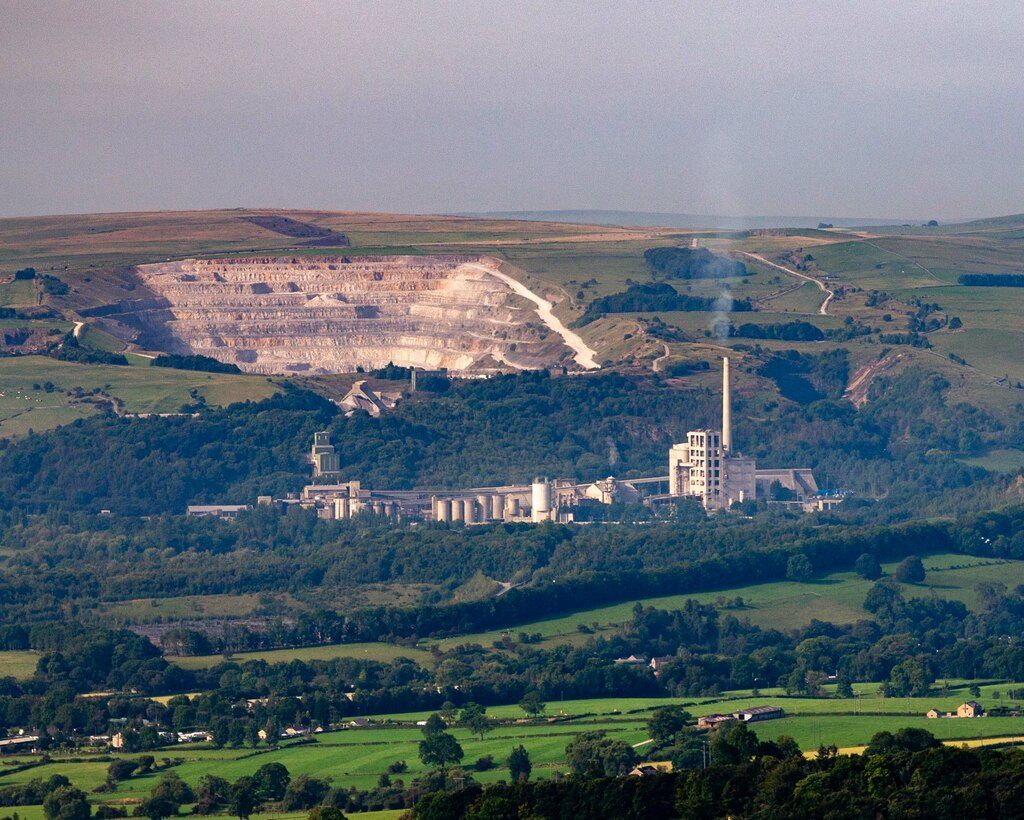
Photo: Hope Cement Works seen from Bamford Edge. Peter McDermott / Geograph, CC BY-SA 2.0
Source: Peak Cluster; Derbyshire Times. Linked: Peak Cluster.
Peak Cluster, the company behind a proposed pipeline to carry captured carbon dioxide away from the Peak District's cement and lime industry, will open a further consultation on 12 November. The consultation will run until 18 December 2026, the company announced on 30 October.
The project aims to capture carbon dioxide produced in making cement and lime and carry it through a new buried pipeline across Cheshire and the Wirral for permanent storage beneath the East Irish Sea seabed. The plants named in coverage of the scheme include Breedon's Hope cement works off Pindale Road in the Hope Valley, Buxton Lime and Tarmac sites at Tunstead, and Holcim's Cauldon works in Staffordshire.
Comments will be taken from 12 November to 18 December
The new consultation asks for views on changes to the project boundary, which is the area within which the company proposes to build permanent infrastructure. It also covers the planned route of the buried pipeline and the proposed locations of above-ground installations, block valve stations, and temporary land needed for access and construction. The company says it has refined the design after its first round of consultation and after technical studies, engineering assessments and environmental surveys. A further round on more detailed aspects of the scheme is planned for summer 2027.
According to the Derbyshire Times, the changes include a more direct route between Hope and Tunstead and the removal of a section between Peak Forest and the north of Dove Holes. An above-ground installation and its search area between Chapel-en-le-Frith and Dove Holes have also been dropped. Peak Cluster has also brought forward consultation on revised plans for the Wirral, where it no longer proposes compression equipment, from January 2027 to the same November start date.
a more direct route between Hope and Tunstead
Peak Cluster chief executive David Parkin said that those who live, work and spend free time in an area "know it best". He said the company wanted further feedback on specific elements, including the proposed route of the buried pipeline and the location of other infrastructure.
In-person events will be held near the places where the project boundary has changed. The nearest to the Chronicle's area is at St Anne's Community Centre in Buxton on 26 November. A Derbyshire public webinar will be held online at 6.30pm on 1 December. Advance registration is required for all events and webinars through the consultation website, peakcluster-consultation.co.uk.
Advance registration is required for all events and webinars
The first phase of consultation, which ran from January to February 2026, drew more than 5,500 responses, according to the Derbyshire Times. Derbyshire County Council and the campaign group Action Against Carbon Capture Storage opposed the scheme at that stage. Because the onshore pipeline is classed as a Nationally Significant Infrastructure Project, the final decision would be made by the Secretary of State for Energy Security and Net Zero after an examination by the Planning Inspectorate.